From DF95 sailboats and scale warships to submarines and a one-of-a-kind hovercraft, our pond took center stage for a worldwide audience
About six weeks ago, popular YouTube creator Hafu Go and his production team visited the San Diego Model Yacht Pond to film a video featuring some of the most unusual and impressive radio-controlled boats they could find.
The finished video has now been released—and it attracted more than 1 million views in its first 48 hours.
With approximately 20 million YouTube subscribers, Hafu Go has built a huge global audience through fast-paced videos exploring extraordinary vehicles, machines and experiences. His latest production compares RC boats ranging from a homemade $1 steam-powered “pop-pop” boat to an extremely powerful custom RC speedboat valued at approximately $10,000.
Along the way, several San Diego Argonauts members—and a wonderfully diverse collection of vessels—received their moment in the spotlight.
From the Slowest “Pop-Pop” to a 130-MPH Speed Demon
The video showcases an astonishing range of RC boats, beginning with a homemade $1 “pop-pop” boat powered by a tiny candle and steam—possibly the slowest and simplest vessel ever launched at our pond. From there, Hafu tests fishing boats, self-righting speedboats, hydrofoils, hovercraft, sailboats, submarines and museum-quality scale ships. At the opposite extreme is a highly customized, approximately $10,000 speed demon capable of exceeding 130 miles per hour. Seeing such radically different vessels together—from a gently puttering tin boat to a carbon-reinforced rocket skimming across the water—beautifully captures the extraordinary variety found within the world of radio-controlled boating.
Hafu Learns to Sail a DragonFlite 95
One of the highlights begins when Hafu is introduced to the DragonFlite 95, or DF95, one of the most popular radio-controlled racing sailboats in the world.
San Diego Argonauts members Jon Rogers & Kerim Baran gives Hafu a quick introduction to the controls and explains some basic sailing concepts—including tacking, jibing, sail trim and how to recover when a sailboat gets caught “in irons.”
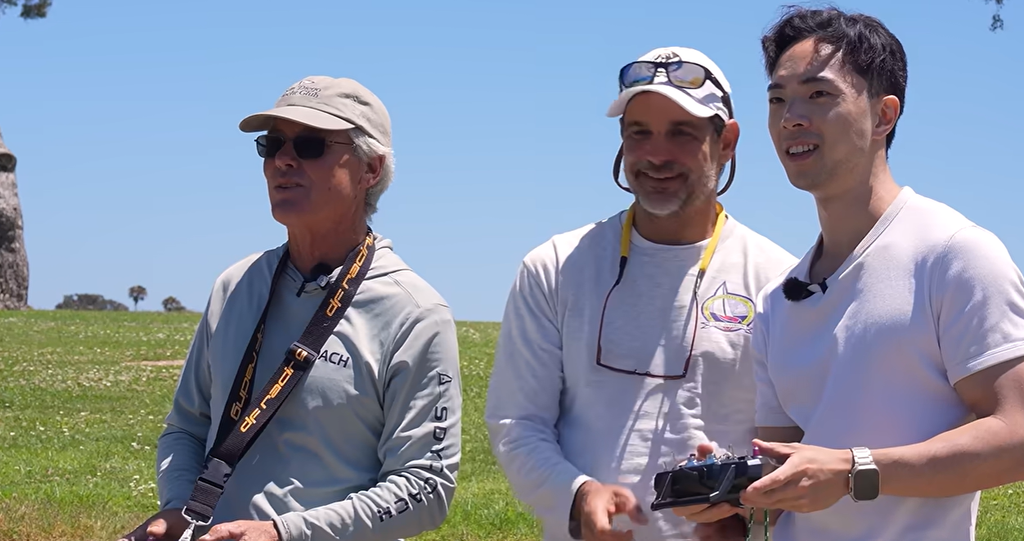
Hafu then takes control of Kerim’s bright-green DF95 and races against longtime sailor and fellow Argonaut Jon Rogers, who tells him he has been sailing for 49 years.
With Kerim coaching from the shore, Hafu learns remarkably quickly. Jon even introduces him to a little sailboat-racing strategy by attempting to block his wind. Hafu ultimately crosses the finish first—although, as he readily admits in the video, Jon may have helped make that victory possible!
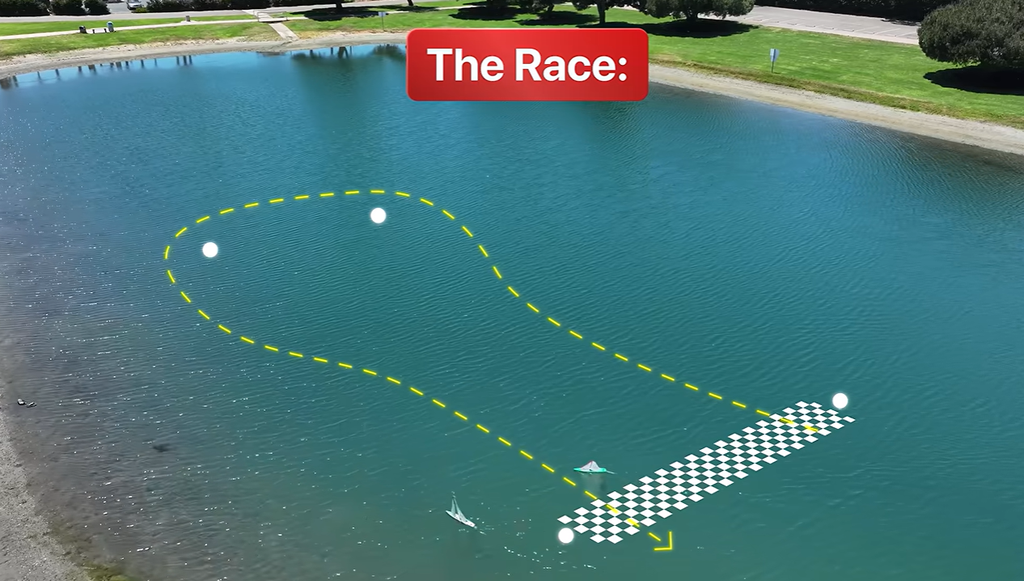
The short sequence offers millions of viewers a fun and approachable introduction to radio sailing. It demonstrates that these boats are not simply toys: they require an understanding of wind, strategy, boat handling and racing tactics.
A Submarine Beneath the Pond
The video then moves below the surface with a Thunder Tiger Neptune RC submarine, demonstrated by submarine expert Bob Martin of Nautilus Drydocks.
Bob explains how the submarine’s ballast system takes in water to make the vessel heavier and dive, then expels the water to become buoyant and return to the surface.
As the submarine slowly disappears beneath the pond, Hafu comments on how peaceful and fishlike it looks. Bob agrees that operating an RC submarine can be a surprisingly relaxing experience.
It is a wonderful demonstration of another fascinating corner of the model-boating world—one that combines craftsmanship, electronics, radio systems, propulsion, buoyancy and careful underwater navigation.
Museum-Quality Bismarck
The scale-model side of the hobby is represented by another Argonaut and his highly detailed RC model of the German battleship Bismarck.
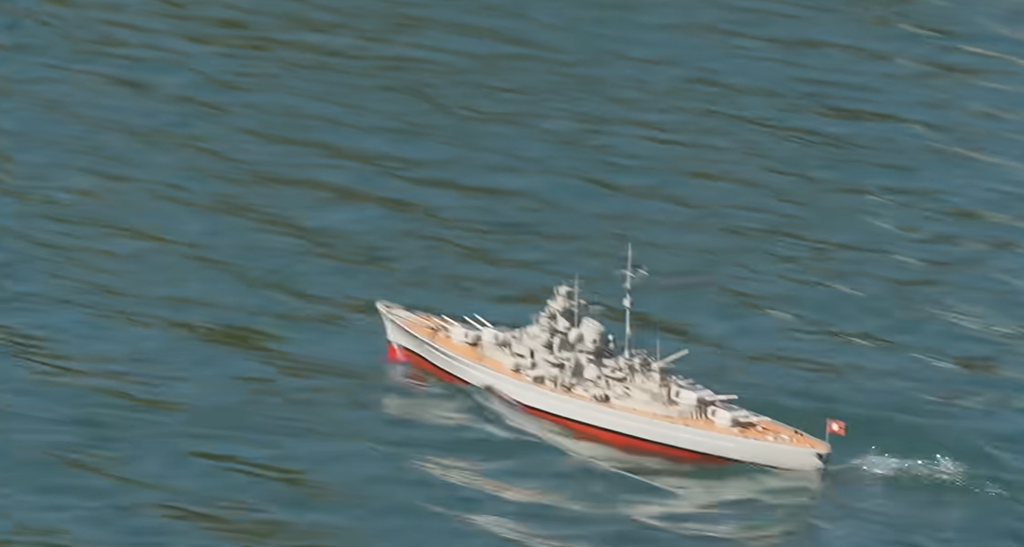
Hafu explains that scale modeling is not primarily about achieving the greatest speed. Instead, the goal is to reproduce a real vessel with as much accuracy and detail as possible.
The Bismarck glides across the pond while the camera captures its intricate fittings and realistic appearance. Mateo describes it as looking like a museum piece—and Hafu readily agrees.
For viewers who may associate RC boating only with small, fast powerboats, this segment provides a glimpse into the historical research, patience and model-building skill involved in producing a fine-scale vessel.
Robin’s One-of-a-Kind Hovercraft
Perhaps the most unusual San Diego Argonauts vessel in the entire video is Robin Cahill Simpson’s custom-built hovercraft.
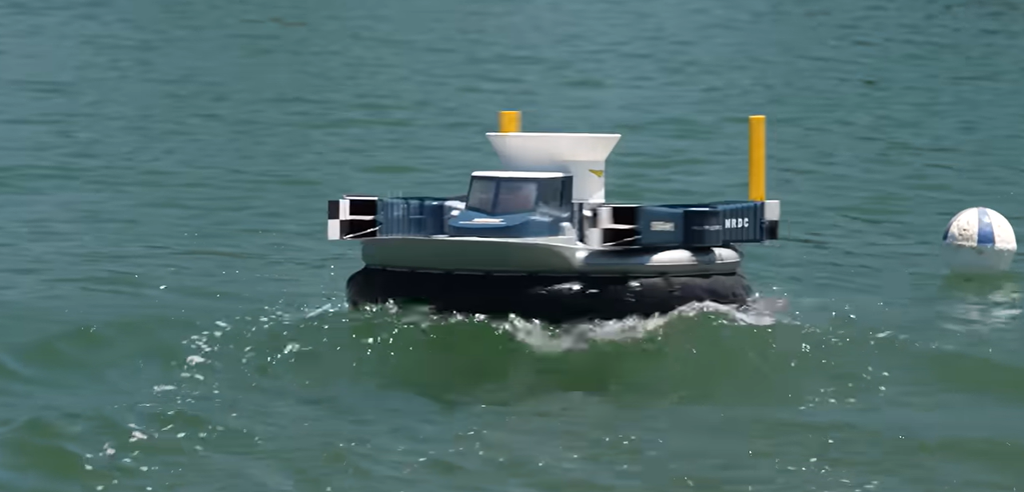
The model is approximately one-tenth scale and is based on the first full-sized hovercraft to cross the English Channel. Robin explains that the project took approximately two or three years to build, followed by another year of solving technical problems and getting it to operate properly.
The result is spectacular.
The hovercraft travels across the pond on a cushion of air, transitions onto land and even performs a spin for the camera. Hafu describes it as looking like a UFO and calls it one of the coolest vessels in the video.
It is believed to be the only operating model of its kind in the world—a wonderful example of the ingenuity, perseverance and craftsmanship found within the San Diego Argonauts.
More Than Boats: Sharing the Hobby With a New Generation
The video is entertaining, energetic and often very funny. But for organizations such as the San Diego Argonauts and all American Model Yachting Association (AMYA) Clubs, it also illustrates something important.
Millions of people—especially young people—may never have seen a competitive RC sailboat, an operating scale warship, a functional RC submarine or a scratch-built hovercraft. A single well-produced YouTube video can introduce the hobby to an audience far larger than any club could reach through a traditional event or advertisement.
In this instance, Hafu Go found the San Diego Argonauts. His team was searching for interesting boats and knowledgeable people, and our members were delighted to welcome them to the pond, provide vessels and help bring the production to life.
But this same opportunity may exist for many other AMYA and model-boating clubs.
There are thousands of YouTube, TikTok, Instagram and other digital creators looking for unusual stories, visually interesting machines, talented builders and authentic experiences. Model-boating clubs have all of those things—as well as colorful personalities, remarkable history and members who love sharing what they know.
Clubs do not necessarily need to wait to be discovered. They can identify creators in their regions, invite them to a sailing day, offer them an opportunity to operate a boat, introduce them to an experienced builder or arrange a friendly race. The strongest collaborations allow creators to tell the story in their own style while club members provide the knowledge, equipment and welcoming environment that make the experience possible.
One creator visit could introduce radio sailing and model boating to hundreds of thousands—or even millions—of potential new enthusiasts.
Welcome to Our Pond
We congratulate Hafu Go and his team on the release and thank them for visiting the San Diego Model Yacht Pond. We also thank the San Diego Argonauts members and other model-boating experts who contributed their time, knowledge and extraordinary vessels to the production.
For our club, it was a memorable day at the pond. For viewers around the world, we hope it will be an invitation to discover the creativity, engineering, camaraderie and sheer fun of model boating.
And for our fellow AMYA clubs, perhaps it will inspire the next great collaboration.
Sometimes the best way to grow our hobby is simply to place a transmitter in someone’s hands—and let the wind, the water and the boats do the rest.